Loverock Road, Reading
- 360 Garage
- 360 Alloys
Garage, MOT, diagnostics, mechanical repairs, performance and alloy-wheel refurbishment.
119 Unit 4 Loverock Road, Reading, RG30 1DZMonday – Friday: 9:00am – 6:00pm
Weekend: By appointment only
360 Garage
A weak or warm air conditioning system is rarely fixed by simply adding refrigerant. We pressure test and leak-check the system first, then regas using the refrigerant type your vehicle actually requires, so the underlying cause is addressed rather than temporarily masked.
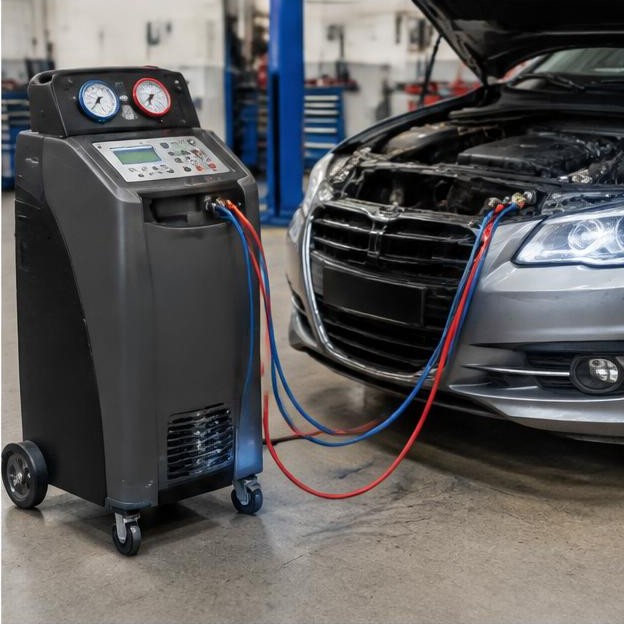
A vehicle air conditioning system is a sealed refrigerant loop made up of a compressor, condenser, evaporator, expansion valve or orifice tube, and a network of pipework and seals. The compressor, driven by the engine or, in hybrid and electric vehicles, by a dedicated electric motor, pressurises refrigerant gas. It pushes the gas through the condenser at the front of the car, where it releases heat and turns to a liquid. That liquid then passes through an expansion device into the evaporator inside the cabin, where it expands, absorbs heat from the air passing over it, and cools the air blown into the vehicle.
Refrigerant type matters because different vehicles use different gases, most commonly R134a on older vehicles and R1234yf on newer ones, and the two are not interchangeable. Using the wrong refrigerant, or mixing types, can damage seals, contaminate the system and, in some cases, create a genuinely unsafe outcome. Before any work is carried out we confirm which refrigerant a vehicle is designed for and use only that type.
The most common reason an air conditioning system stops cooling effectively is a slow refrigerant leak, since even a small loss of refrigerant significantly reduces cooling performance long before the system runs completely empty. Simply topping up refrigerant without finding and fixing the leak means the same fault will recur, often within weeks or months. The customer ends up paying repeatedly for a temporary fix rather than once for a proper repair. This is why we treat 'blind regassing' — adding refrigerant without testing the system first — as poor practice we do not carry out.
Proper diagnosis starts with pressure testing the system while it is running, comparing readings on the high and low pressure sides against expected values for the ambient conditions. Abnormal pressures point toward specific faults. Low pressure on both sides typically suggests a leak or low refrigerant charge, while other pressure patterns can indicate a failing compressor, a blocked expansion device, or a restriction elsewhere in the system. From there, dedicated leak-detection methods, including UV dye tracing and electronic leak detectors, are used to pinpoint exactly where refrigerant is escaping.
How it works
Initial assessment
We check the reported symptom, current system performance and any previous air conditioning work carried out on the vehicle.
Pressure testing
The system is connected to diagnostic gauges and run to compare high and low side pressures against expected values, identifying the likely category of fault.
Leak detection
UV dye tracing and electronic leak detection are used to pinpoint the exact source of refrigerant loss, rather than assuming a leak location.
Repair
The identified fault, whether a seal, pipe, condenser or compressor issue, is repaired or the component replaced as appropriate.
Evacuation and recharge
The system is evacuated to remove air and moisture, then recharged with the correct refrigerant type, quantity and compressor oil for that specific vehicle.
Performance verification
We check vent temperature and system behaviour to confirm the repair has resolved the fault before returning the vehicle.
Capability
The compressor is the heart of the system, pressurising refrigerant gas so it can release heat later in the cycle. In conventional vehicles it is driven by a belt from the engine and engages through an electromagnetic clutch. Hybrid and electric vehicles typically use a dedicated electric compressor that can run independently of the engine.
The condenser, mounted at the front of the vehicle alongside the radiator, allows the hot, pressurised refrigerant gas to release heat to the outside air and condense into a liquid. A condenser that is damaged, blocked with debris, or has restricted airflow cannot release heat efficiently, reducing overall cooling performance.
The expansion valve or orifice tube creates a pressure drop as refrigerant passes into the evaporator, causing it to expand rapidly and turn back into a gas. This expansion absorbs heat from the surrounding air, which is why the evaporator, mounted inside the dashboard, becomes cold and cools the air blown across it into the cabin.
Refrigerant type is not interchangeable between systems. R1234yf, used on newer vehicles, has different properties and handling requirements to the older R134a, and using the wrong type can damage seals designed for a different chemical composition and compromise system performance.
Blind regassing, adding refrigerant without pressure testing or leak detection first, treats a symptom rather than a cause. Because refrigerant systems are sealed, any drop in charge means refrigerant has escaped somewhere, and finding that point is the only way to prevent the same fault recurring.
Air conditioning refrigerant systems are sealed by design, so any noticeable drop in performance almost always indicates a leak. Adding refrigerant without testing and diagnosing the system first only masks the symptom temporarily and can mean a customer pays repeatedly for the same unresolved fault. We assess before we recharge, and we will explain clearly where a repair is more involved than a straightforward regas.
Why 360
Garage, MOT, diagnostics, mechanical repairs, performance and alloy-wheel refurbishment.
119 Unit 4 Loverock Road, Reading, RG30 1DZMonday – Friday: 9:00am – 6:00pm
Weekend: By appointment only
Questions
Related work
360 Garage
Interim, full and manufacturer-schedule servicing in Reading for all makes and models, with digital service records and warranty preserved.
360 Garage
Proper fault diagnosis in Reading, including live data analysis and road testing, for warning lights and intermittent faults on all makes, EV and hybrid included.
360 Garage
High-voltage qualified electric and hybrid vehicle servicing in Reading, covering routine maintenance, brakes, cooling and 12V systems.
360 Garage
Mechanical repairs in Reading covering engine, cooling, electrical, exhaust and starting faults on all makes and models, with clear findings before any work.
All 360 Garage servicesLoverock Road, ReadingAreas we coverContact 360
360 Garage
MOTs, servicing, diagnostics, repairs and performance upgrades.