Loverock Road, Reading
- 360 Garage
- 360 Alloys
Garage, MOT, diagnostics, mechanical repairs, performance and alloy-wheel refurbishment.
119 Unit 4 Loverock Road, Reading, RG30 1DZMonday – Friday: 9:00am – 6:00pm
Weekend: By appointment only
360 Alloys
Powder coating applies a dry, electrostatically charged powder finish that is then cured under heat to form a hard, even, durable coating across the whole wheel. It stands up well to stone chips, wheel cleaners and general road use, and we complete every stage in-house.
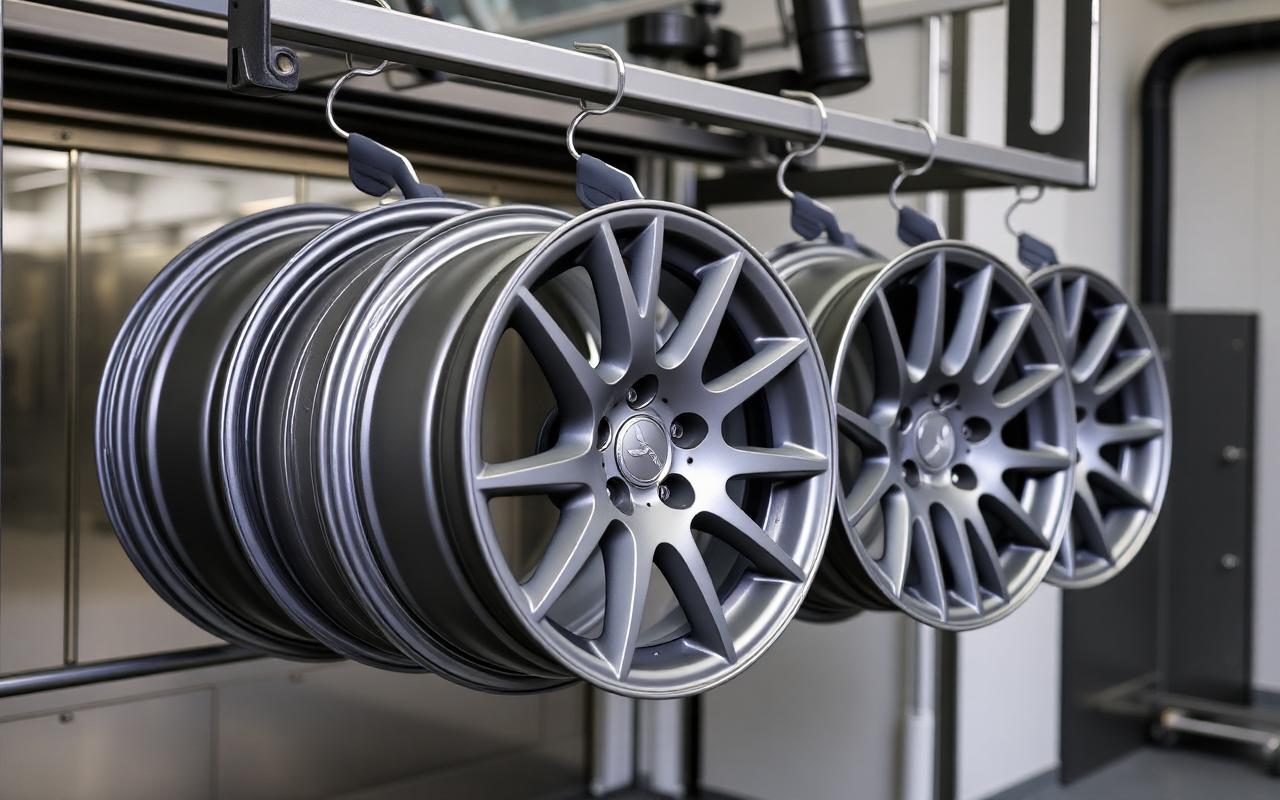
Powder coating is fundamentally different from a standard painted finish, even though both can end up looking similar to the eye. Rather than being sprayed on as a wet liquid, the coating starts as a dry powder that is applied to the wheel using an electrostatic charge. This attracts the powder particles evenly across the whole surface, including into recesses that a wet spray can sometimes miss. The wheel is then baked in an oven, where the powder melts and fuses into a single continuous layer.
That curing process is what gives powder coating its durability. Because the coating flows and bonds as one solid layer rather than drying from multiple separate wet coats, it tends to be more resistant to chipping, fading and general wear. This is compared with a simple painted finish of comparable colour. It is a genuinely sensible choice for wheels that take a lot of road abuse, or for anyone who wants a long-lasting finish without the ongoing maintenance a bare diamond-cut face requires.
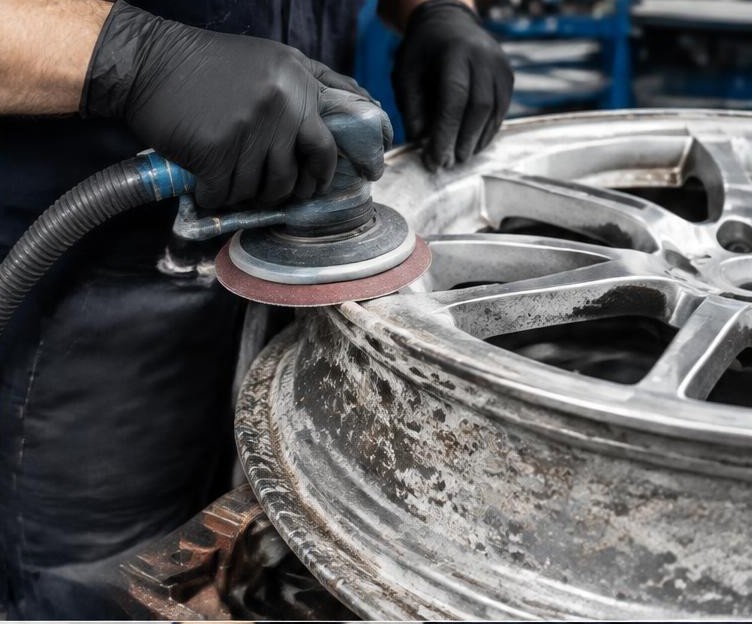
Before any powder is applied, the wheel goes through the same stripping and preparation process as any other refinishing job. Old paint, lacquer and any corrosion are removed back to sound bare alloy. Powder coating applied over a poorly prepared surface will fail at the same weak points a paint job would — the coating is only as good as the surface underneath it. Corrosion in particular needs to be fully treated before coating, since sealing corrosion under a fresh coating does not stop it continuing to spread beneath the surface.
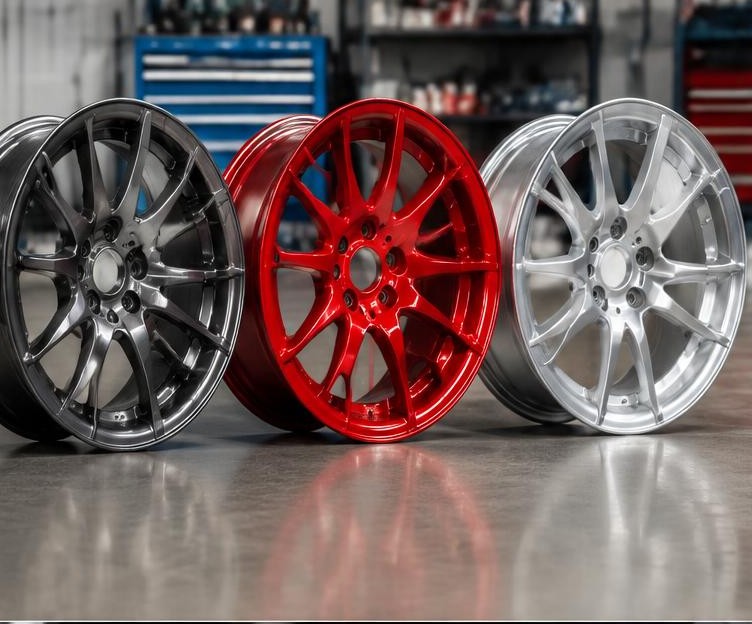
We offer gloss, satin and matt finishes across a wide range of colours, and can discuss OEM-style shades as well as custom colours. Gloss gives the shiniest, most reflective finish and is the closest match to most factory colours. Satin sits between gloss and matt with a soft sheen. Matt gives a completely flat, non-reflective finish that has become popular on modern performance and SUV-style wheels. All three are applied and cured using the same underlying process, with the finish sheen determined by the powder used.
How it works
Stripping
The wheel is stripped of its existing paint, lacquer and any old coating back to bare alloy, so the new powder coat is bonding to sound metal rather than sitting over a compromised surface.
Preparation and corrosion treatment
Any corrosion is treated back to sound alloy, and the surface is cleaned and prepared to give the powder coating the best possible surface to bond to.
Powder application
Powder is applied using an electrostatic process that draws it evenly across the wheel's surface, including recesses and spoke edges that a wet spray can sometimes leave thin.
Curing
The wheel is baked at a controlled temperature so the powder melts and fuses into a single continuous coating, which is what gives powder coating its durability compared with wet paint.
Finish and quality check
Once cooled, the wheel is checked for even coverage, correct sheen level and consistent colour, particularly important where a full set is being finished together.
Capability
The electrostatic application stage is central to why powder coating is so even. Powder particles carry an electrical charge as they are applied, and the wheel is earthed. This means the charged particles are drawn onto the metal surface uniformly, rather than relying purely on spray direction and pressure the way wet paint does.
Curing at high temperature causes the powder to melt and flow together into a single film, chemically cross-linking as it cools. This is fundamentally different to a wet paint system, which dries through solvent evaporation across multiple thinner coats. The fused nature of a cured powder coat is generally what gives it better resistance to chipping and abrasion.
None of this durability matters if the surface underneath is not properly prepared, which is why stripping and corrosion treatment happen before any powder goes on. Coating over corrosion or residual old paint traps the problem underneath a durable shell, and the coating will eventually fail at that weak point regardless of how well it was applied on top.
Gloss, satin and matt are achieved through different powder formulations rather than different application techniques, so the choice of sheen does not affect the coating's underlying durability — it is purely a visual preference.
Powder coating is a durable cosmetic and protective finish, but it is not indestructible. Heavy kerb impacts can still chip or crack the coating, and it does not correct structural damage such as cracks or buckling. That damage needs separate assessment and repair before or instead of coating.
Why 360
Warranty
Garage, MOT, diagnostics, mechanical repairs, performance and alloy-wheel refurbishment.
119 Unit 4 Loverock Road, Reading, RG30 1DZMonday – Friday: 9:00am – 6:00pm
Weekend: By appointment only
Questions
Related work
360 Alloys
Complete in-house alloy wheel refurbishment in Reading: strip, repair, prime, finish and lacquer, with a twelve-month warranty.
360 Alloys
In-house diamond cutting for alloy wheels in Reading, machined on our own lathe with corrosion checked before every cut.
360 Alloys
Alloy wheel corrosion repair in Reading, properly stripping and treating lacquer failure, pitting and bead-seat corrosion.
360 Alloys
OEM-style, custom and shadow finishes for alloy wheels in Reading, with colour sampling and consistent results across a full set.
All 360 Alloys servicesLoverock Road, ReadingAreas we coverContact 360
360 Alloys
Complete wheel refurbishment, diamond cutting and structural alloy repair.