Loverock Road, Reading
- 360 Garage
- 360 Alloys
Garage, MOT, diagnostics, mechanical repairs, performance and alloy-wheel refurbishment.
119 Unit 4 Loverock Road, Reading, RG30 1DZMonday – Friday: 9:00am – 6:00pm
Weekend: By appointment only
360 Alloys
A buckled wheel has been knocked out of true, usually by a pothole or hard kerb strike, and typically shows up as a vibration through the steering or seat. We assess the wheel structurally before attempting any straightening, and will recommend replacement rather than repair where that is the safer option.
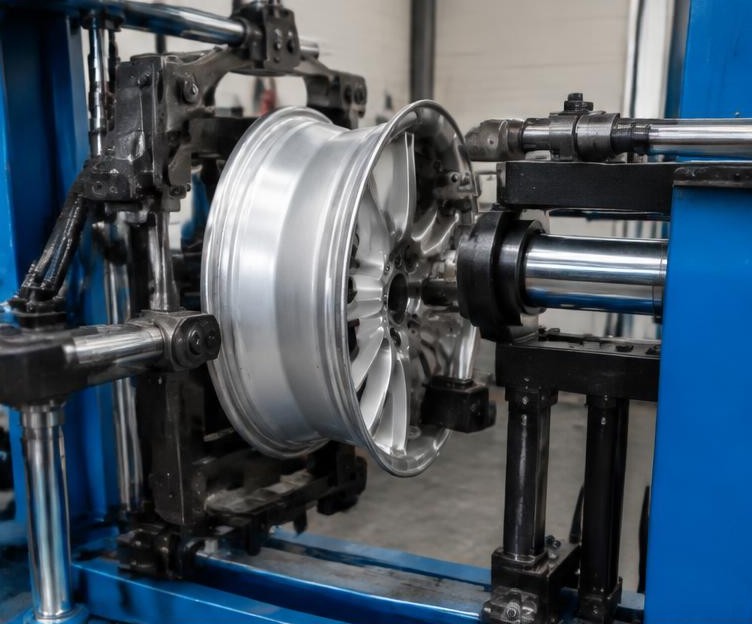
A buckled wheel is one that has been bent or deformed out of its true, round shape. This is almost always the result of a hard impact — most commonly a pothole strike, but sometimes a kerb impact taken at an awkward angle. Unlike a puncture, a buckle affects the metal wheel itself rather than the tyre, and it changes how the wheel runs even if the tyre holds air perfectly well.
The two technical terms that matter here are radial runout and lateral runout, and both describe the same basic idea in different directions. Radial runout is how much the wheel's rolling circle varies as it rotates — essentially whether the wheel is properly round or slightly egg-shaped after the impact. Lateral runout is how much the wheel wobbles side to side as it spins, like a plate that is not sitting flat. Either type of runout beyond a normal tolerance will cause the wheel to run unevenly, and both are measurable on a proper balancing and runout check.
In practical terms, a buckled wheel usually announces itself as a vibration felt through the steering wheel at certain speeds, sometimes changing character or intensity as speed increases. It is often a vibration that a standard wheel balance does not fully resolve. This is a key distinction: balancing corrects for uneven weight distribution around the wheel, while a buckle is a physical shape distortion, so no amount of balancing weight will fix a genuinely bent wheel. If a wheel keeps needing rebalancing or the vibration returns quickly, a buckle is worth checking for.
Buckled wheels can also cause slow air loss, particularly where the deformation affects the bead seat — the precise surface the tyre's edge seals against. Even a small distortion here can be enough to break that seal slightly and let air escape gradually. This is similar to how a crack can cause air loss, but through mechanical distortion rather than a break in the metal.
How it works
Initial inspection
The wheel is examined visually and by hand-spinning where possible, looking for obvious signs of distortion, and checked against the reported symptoms such as vibration or air loss.
Runout measurement
Radial and lateral runout are measured using proper equipment to establish the extent and nature of the buckle, rather than relying on visual assessment alone.
Structural and crack check
Because a hard enough impact to buckle a wheel can also crack it, we check thoroughly for any associated cracking before deciding whether straightening is appropriate.
Controlled straightening
Where straightening is appropriate, the wheel is worked back towards its correct shape using specialist equipment, sometimes with controlled heat depending on the alloy, applied carefully to avoid introducing new stress.
Balancing and final check
The straightened wheel is refitted with its tyre, rebalanced, and rechecked for runout to confirm the vibration and shape issue has actually been resolved.
Capability
Radial runout describes how much a wheel's rolling radius changes as it completes one full rotation. Picture the wheel as a circle. If that circle is not perfectly round — even by a small amount — the distance from the centre to the outer edge varies slightly as it spins. That variation translates into a vibration you can feel, particularly at higher speeds.
Lateral runout describes side-to-side wobble as the wheel spins, as though the wheel is not sitting perfectly flat on its axis. This produces a different kind of vibration to radial runout, sometimes described as a wobble rather than a bounce. It often comes from an impact that has bent the wheel slightly out of plane rather than out of round.
Balancing and runout correction address two different problems. Balancing adds small weights to counteract uneven mass distribution around an otherwise correctly shaped wheel. Straightening physically corrects the shape of a wheel that has been bent. A vibration caused by runout will not be resolved by balancing alone. This is why persistent vibration after a fresh balance is one of the clearer signs of a buckle rather than a simple weight issue.
Heat is sometimes used carefully during straightening because it allows the alloy to be worked with less risk of cracking than attempting to bend cold metal back into shape. The amount of heat and the technique used depend on the specific alloy and the extent of the distortion, and this is judged individually rather than applied as a standard step to every wheel.
Not every buckled wheel should be straightened. Where the distortion is severe, where cracking is found alongside the buckle, or where the wheel's condition makes a safe and lasting straightening outcome unlikely, we will recommend replacement rather than attempting a repair.
Why 360
Warranty
Garage, MOT, diagnostics, mechanical repairs, performance and alloy-wheel refurbishment.
119 Unit 4 Loverock Road, Reading, RG30 1DZMonday – Friday: 9:00am – 6:00pm
Weekend: By appointment only
Questions
Related work
360 Alloys
Careful assessment and repair of cracked alloy wheels in Reading, with honest advice when a wheel cannot be safely repaired.
360 Alloys
Complete in-house alloy wheel refurbishment in Reading: strip, repair, prime, finish and lacquer, with a twelve-month warranty.
360 Alloys
Alloy wheel corrosion repair in Reading, properly stripping and treating lacquer failure, pitting and bead-seat corrosion.
All 360 Alloys servicesLoverock Road, ReadingAreas we coverContact 360
360 Alloys
Complete wheel refurbishment, diamond cutting and structural alloy repair.