Loverock Road, Reading
- 360 Garage
- 360 Alloys
Garage, MOT, diagnostics, mechanical repairs, performance and alloy-wheel refurbishment.
119 Unit 4 Loverock Road, Reading, RG30 1DZMonday – Friday: 9:00am – 6:00pm
Weekend: By appointment only
360 Alloys
Freshly refurbished wheels tend to make tired-looking calipers behind them far more obvious. Caliper painting is a cosmetic finish carried out with proper preparation, masking and suitable heat-resistant coatings, and it is not a claim of any improvement to braking performance.
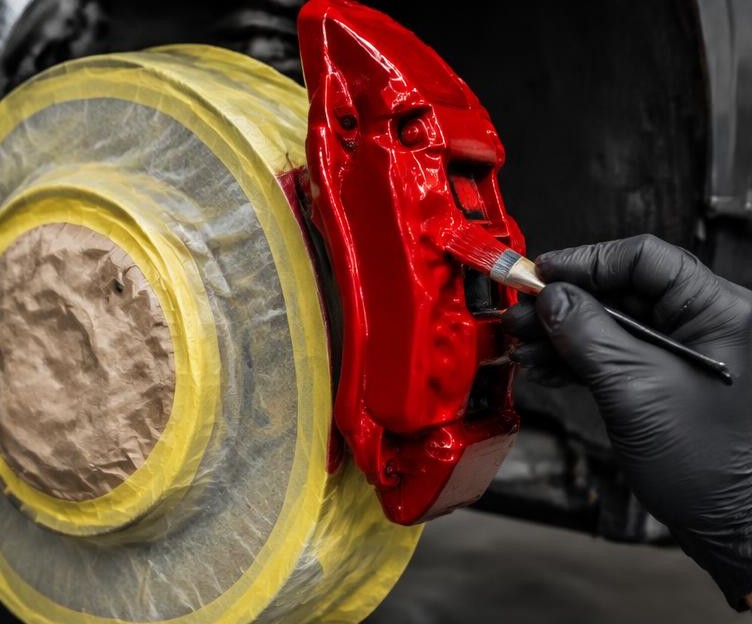
Caliper painting is one of those jobs that makes most sense at a particular moment: when the wheels are already off the car for another reason. Once a wheel refurbishment or repair has the tyre and wheel removed, the caliper behind it is fully exposed and accessible in a way it simply is not with the wheel fitted. This is why we routinely offer caliper painting alongside wheel work, rather than as a job requiring a separate visit and separate wheel removal.
The process starts with proper preparation, because paint applied over grime, brake dust and old flaking coating will not last regardless of the coating used. The caliper is thoroughly cleaned to remove built-up brake dust, road grime and any residue, and any existing loose or flaking paint is removed so the new coating has a sound surface to bond to.
Masking is a genuinely careful stage of this job, because a caliper sits extremely close to several components that must never be painted over. The brake pads, the disc itself, the wheel bearing area and, critically, the rubber seals and bleed nipple components all need to be properly protected during masking. Paint or overspray on any of these can affect their function, seal integrity or, in the case of the disc and pads, the braking surface itself.
We use coatings specifically suited to the heat a caliper experiences during braking. Calipers get genuinely hot in normal use, and a standard decorative paint would not stand up to that heat cycling without discolouring, cracking or peeling. These coatings are chosen and applied specifically because they are formulated to tolerate that environment.
How it works
Cleaning and preparation
The caliper is thoroughly cleaned to remove brake dust, road grime and any loose or flaking existing paint, giving the new coating a sound, clean surface to bond to.
Masking
Brake pads, the disc surface, seals, and the bleed nipple and its cap are carefully masked and protected, since none of these should come into contact with paint or overspray.
Coating application
A heat-resistant coating is applied in the agreed colour, chosen specifically because it is formulated to withstand the heat a caliper experiences during normal braking.
Curing
The coating is cured following the process appropriate to that specific product, ensuring it hardens properly before the wheel goes back on and the car returns to the road.
Unmasking and inspection
Masking is removed carefully and the caliper is inspected to confirm no paint has reached the pads, disc, seals or bleed components before the wheel is refitted.
Capability
A caliper's braking function depends entirely on its pads gripping a clean disc surface and its rubber seals maintaining hydraulic pressure without leaking. Paint or overspray reaching either of these would be a genuine functional problem, not just a cosmetic one. This is why masking these areas properly is treated as a critical part of the job rather than a quick step.
The bleed nipple is a small but important component allowing air to be bled from the brake fluid system when needed. If it becomes coated in paint, it can become difficult to operate correctly during future brake servicing, which is another reason it is specifically masked and protected during caliper painting.
Calipers experience significant heat during braking, generated by friction between the pads and the disc, and this heat is partially conducted into the caliper body itself. A standard decorative paint not designed for this environment can discolour, blister or peel with repeated heat cycling, which is why coatings specifically formulated for this application are used rather than a generic paint.
Because caliper painting is purely cosmetic, it has no effect on braking performance, pedal feel or stopping distance. Those depend entirely on the condition of the pads, discs, brake fluid and the mechanical components of the braking system. We are clear about this distinction so there is no confusion about what the service achieves.
Caliper painting is a cosmetic service and does not involve work on the braking system itself. It does not improve, and should never be assumed to improve, braking performance, and any braking concerns should be raised separately as a mechanical inspection rather than addressed through cosmetic caliper work.
Why 360
Garage, MOT, diagnostics, mechanical repairs, performance and alloy-wheel refurbishment.
119 Unit 4 Loverock Road, Reading, RG30 1DZMonday – Friday: 9:00am – 6:00pm
Weekend: By appointment only
Questions
Related work
360 Alloys
Complete in-house alloy wheel refurbishment in Reading: strip, repair, prime, finish and lacquer, with a twelve-month warranty.
360 Alloys
OEM-style, custom and shadow finishes for alloy wheels in Reading, with colour sampling and consistent results across a full set.
360 Alloys
Durable in-house powder coating for alloy wheels in Reading, with gloss, satin and matt options and proper corrosion preparation.
All 360 Alloys servicesLoverock Road, ReadingAreas we coverContact 360
360 Alloys
Complete wheel refurbishment, diamond cutting and structural alloy repair.