Loverock Road, Reading
- 360 Garage
- 360 Alloys
Garage, MOT, diagnostics, mechanical repairs, performance and alloy-wheel refurbishment.
119 Unit 4 Loverock Road, Reading, RG30 1DZMonday – Friday: 9:00am – 6:00pm
Weekend: By appointment only
360 Alloys
A cracked alloy wheel is a safety issue, not just a cosmetic one, because the wheel is a structural component carrying the full weight and load of the vehicle. We assess every crack thoroughly before agreeing to repair it, and we will always tell you honestly if a wheel should be replaced instead.
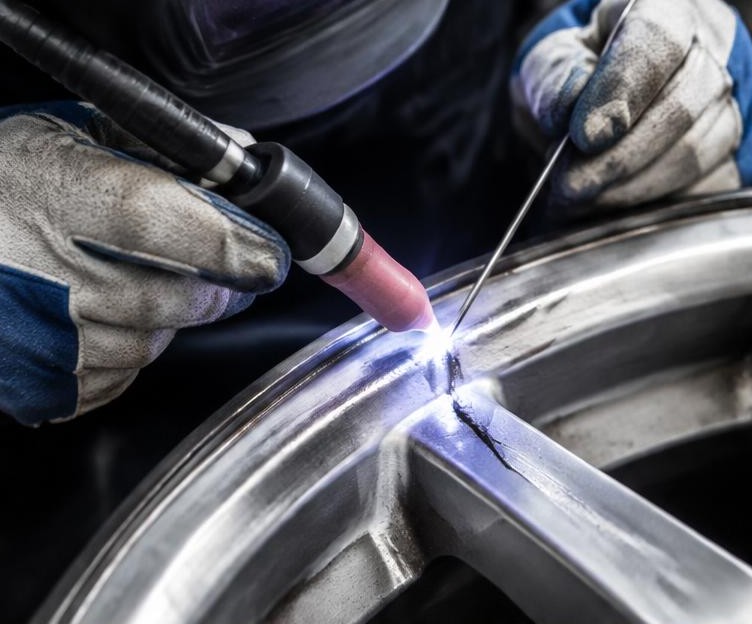
Cracks in alloy wheels are treated with more caution than almost any other type of wheel damage we see, and for good reason. A wheel carries the entire weight of the vehicle at that corner, transmits braking and cornering loads, and does so at speed, repeatedly, over years. A crack that seems small can be the visible tip of stress that runs deeper into the wheel's structure. Getting the assessment wrong has real safety consequences for whoever is driving on that wheel afterwards.
Cracks typically appear in a handful of common locations. These include around the wheel's bolt holes, where repeated clamping and torque loads concentrate stress, and along the spokes, particularly where a spoke meets the wheel's centre or the outer rim. Cracks also appear at the barrel or rim edge, often following a hard pothole or kerb impact that has flexed the wheel beyond what the metal could absorb. Where the crack sits matters as much as its size, because cracks in some locations experience far higher ongoing stress than others.
A cracked wheel commonly shows up first as slow air loss from the affected tyre, since a crack that breaches the wheel's sealing surface lets air escape even without a puncture in the tyre itself. Other times a crack is found visually during an inspection, or after a specific pothole or kerb impact prompts the owner to have the wheel checked. We recommend having any wheel checked promptly after a hard impact, even where there is no obvious sign of damage yet.
We assess every cracked wheel thoroughly before agreeing to any repair. This includes examining the crack's location, length and depth, checking whether it is a single isolated crack or connected to wider stress in the wheel, and considering the wheel's overall condition and repair history. Where we find a previous repair in the area, that also affects our assessment. A wheel that has already been welded once in a given location may not be a good candidate for repeating that repair.
How it works
Initial inspection
The wheel is examined visually and, where needed, with the tyre removed, to identify the crack's exact location, length and whether it connects to any other damage.
Assessment against repair criteria
We assess whether the crack sits in a location and condition that can be repaired safely, taking into account the wheel's overall structural condition and any prior repair history.
Decision and advice
We tell you clearly whether the wheel is a candidate for welding repair or whether replacement is the safer and more sensible option, and explain the reasoning either way.
Welding repair (where appropriate)
The crack is welded using appropriate technique and equipment for alloy wheel repair, addressing the affected area without compromising the surrounding structure.
Post-repair inspection and refinishing
The welded area is inspected closely for integrity before the wheel is refinished to blend the repair with the surrounding surface.
Balancing and final check
The repaired wheel is refitted with its tyre, balanced, and given a final check before being cleared for use.
Capability
Not all cracks carry the same risk. A shallow cosmetic crack in a low-stress area of a spoke is a very different proposition to a crack running through a structural section of the wheel or connecting to the wheel's mounting face. That mounting face sees concentrated load every time the car brakes, accelerates or corners.
Depth matters as much as visible length. A crack that looks short on the surface can run deeper into the metal than it appears, which is why we assess carefully rather than judging purely by what is visible without closer inspection.
A wheel's repair history is a genuine factor in our assessment. Metal that has already been welded once has already been through a heat cycle in that area. Welding it again in the same location carries more risk than welding a wheel that has never been repaired before. We take this into account rather than treating every crack in isolation.
Welding alloy wheels correctly requires matching technique to the specific alloy and the wheel's construction, followed by careful post-weld inspection. It is not a repair that should be attempted casually, and a poorly executed weld can be more dangerous than the original crack, because it may look repaired while remaining structurally compromised.
Not every cracked wheel can be safely repaired, and we will not guarantee that a specific wheel is repairable before we have assessed it in person. Where a crack sits in a structural area, is extensive, or the wheel's condition and repair history make a further weld inadvisable, we will recommend replacement rather than attempting a repair.
Why 360
Warranty
Garage, MOT, diagnostics, mechanical repairs, performance and alloy-wheel refurbishment.
119 Unit 4 Loverock Road, Reading, RG30 1DZMonday – Friday: 9:00am – 6:00pm
Weekend: By appointment only
Questions
Related work
360 Alloys
Assessment and controlled straightening of buckled alloy wheels in Reading, with structural and crack checks before repair.
360 Alloys
Complete in-house alloy wheel refurbishment in Reading: strip, repair, prime, finish and lacquer, with a twelve-month warranty.
360 Alloys
Alloy wheel corrosion repair in Reading, properly stripping and treating lacquer failure, pitting and bead-seat corrosion.
All 360 Alloys servicesLoverock Road, ReadingAreas we coverContact 360
360 Alloys
Complete wheel refurbishment, diamond cutting and structural alloy repair.